Students to help conserve Strata Florida’s historic stables
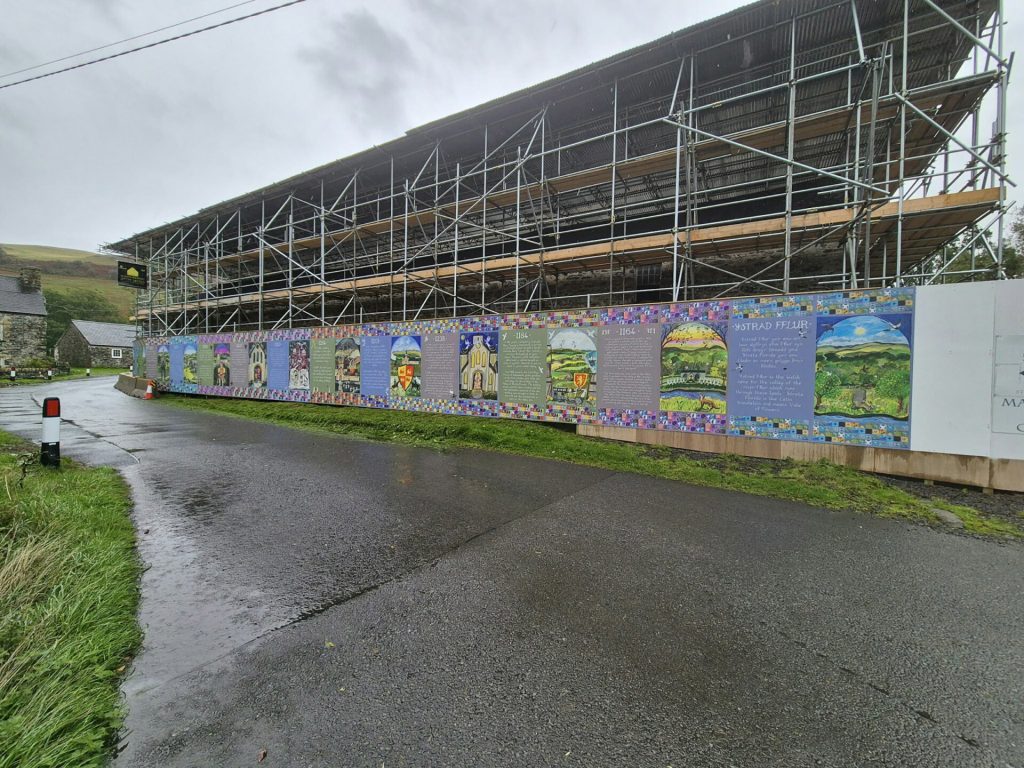
Students will work alongside skilled craftspeople to conserve a historic Stable Block at Strata Florida Abbey, Pontrhydfendigaid, near Tregaron.
Strata Florida Trust and World Monuments Fund (WMF) Britain has announced that the conservation work, which has started, will include adapting the building to create flexible new spaces for educational and cultural programming.
Uniquely, the conservation is part of that programme, creating an opportunity for local students to learn a new craft. In collaboration with local colleges, universities and tradespeople, a traditional building skills programme has been developed.
Participants will have the chance to develop practical skills in traditional stonemasonry, carpentry, slating, plastering and limework, while gaining valuable experience working alongside skilled craftspeople on a real heritage site.
Temporary hoarding around the Stable Block now features a beautiful new mural designed by Driftwood Designs in collaboration with the local community, which informs visitors of the work whilst also celebrating the historical and cultural significance of Strata Florida.
“What makes this project different is that the conservation itself is part of the learning,” explained John Darlington, WFM Britian director of projects. “Over the next two years, students will work alongside skilled craftspeople on a real historic building, following in the footsteps of generations who have built and made things at Strata Florida.
“Instead of practising on a wall that will eventually be taken down, they will be able to point to the Stables and say: ‘I worked on that’. When the work is finished, the Stables will remain a place for learning, craft and culture, continuing a tradition that has been part of Strata Florida for centuries.”
Further details about the project, its partners and the training programme will be announced soon.
The Cistercians who built Strata Florida Abbey first came to the area in 1164. Rhys ap Gruffudd, prince of the kingdom of Deheubarth in South Wales, re-founded the abbey in 1184 and it became a cultural centre for the independent Welsh kingdoms.
Some of the earliest and most important texts in Welsh, including the Hendregadredd and White Book of Rhydderch, are believed to have been written in the abbey and Welsh poets, including the most famous of them all, Dafydd ap Gwilym, sang its praises.
The abbey monks and workers developed a thriving economy within the large estate they had received from ap Gruffudd. However, the abbey paid a price for its association with the Welsh Princes and was caught up in many violent campaigns, culminating in the dissolution of the monasteries in 1539.
The buildings fell into ruin and today only the abbey church ruins remain above ground, while many of the other buildings were repurposed into the later buildings of Mynachlog Fawr farm.
Generations of visitors have found inspiration in a pilgrimage to Strata Florida, including artists, poets and those seeking a respite from the world.
Strata Florida Trus, an independent charity which purchased the historic farm of Mynachlog Fawr in 2016, is currently restoring and converting the Grade II and II* listed farm buildings to new uses.
Since 2019, the trust has run a programme of courses, visits and community events, including the annual Strata Florida Archaeology Field School, which welcomes participants from around the world.
In 2021, the trust opened a free-to-enter exhibition which tells the story of Mynachlog Fawr farmhouse and local and agricultural history, through a range of objects from the house.
Last year, following an agreement with Cadw, the trust took on the management of Strata Florida Abbey and its grounds and re-opened the Abbey Visitor Centre which now offers a range of local merchandise and refreshments.